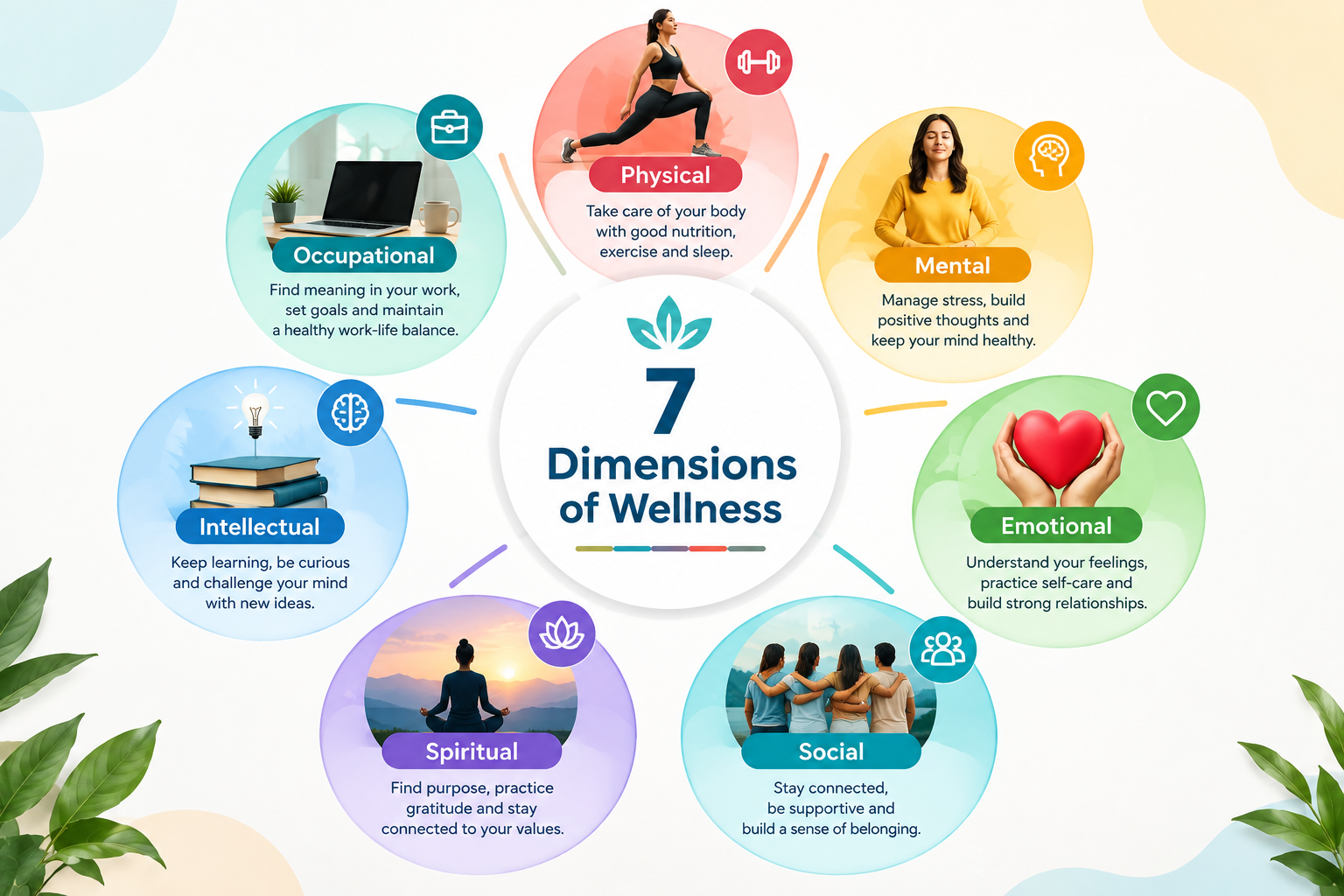
The 7 dimensions of wellness are an innovative approach to understanding health as something more than merely not being sick. Rather than only emphasizing either physical exercises or healthy eating, this method provides a look into seven areas of one’s life that can help understand the overall state of well-being: physical, intellectual, emotional, spiritual, environmental, social, and occupational.
The model was originated by Dr. Bill Hettler at the National Wellness Institute and is actively utilized by various health and wellness specialists and programs.
1. Physical Wellness
Physical wellness refers to the act of taking care of the body through movement, nutrition, sleep, and preventive health care; although this is the area of wellness people usually think of first, it has more to do with more than just exercise.
To support physical wellness:
- Move regularly in a way that suits your body and your schedule, instead of solely doing workouts
- Take sleep seriously as well as nutrition and exercise
- Participate in preventive medical checkups and medical care regime
- Basic habits make more difference than one might think, as even such simple one as drinking water are contributing to physical wellness. For more information, check our article 5 Tips to Stay Hydrated.
2. Emotional Wellness
- Emotional wellness means being aware of, accepting, and handling your feelings in a healthy way — and by that, it does mean avoiding burying your feelings or letting them control you. It is also connected with resilience, the ability to handle stress, and staying generally optimistic without denying negative feelings.
- Seek ways to promote it:
- Identify your feelings rather than ignoring them
- Think of a few general methods of resisting stress — writing about it, talking to someone, or exercising
- Pay attention to the pattern — do you keep feeling stressed or down?
3. Intellectual Wellness
Intellectual wellness entails an inquisitive and energetic approach to life, working to acquire new knowledge, resolve issues, and exercise sound judgment on a continued basis. Intellectual wellness does not rely on formal education; it depends more on an ongoing pattern of activity.
Here are ways to promote intellectual wellness:
- Read or learn outside your normal area of work or activities
- Accept responsibilities that involve genuine problem-solving, instead of repetitive tasks
- Engage in discussions that make you think and not just reinforce your ideas
4. Spiritual Wellness
Intellectual wellness entails an inquisitive and energetic approach to life, working to acquire new knowledge, resolve issues, and exercise sound judgment on a continued basis. Intellectual wellness does not rely on formal education; it depends more on an ongoing pattern of activity.
Here are ways to promote intellectual wellness:
- Read or learn outside your normal area of work or activities
- Accept responsibilities that involve genuine problem-solving, instead of repetitive tasks
- Engage in discussions that make you think and not just reinforce your ideas
5. Environmental Wellness
- Environmental wellness refers to your interaction with the many aspects around you; your personal environment and the larger world it is part of. Environmental wellness deals with the effects of your surroundings on you and vice versa.
- You can help preserve environmental wellness by ensuring that your workplace and home are as organized and comfortable as practical, spending time outdoors when appropriate, and practicing sustainability where appropriate.
6. Social Wellness
- Social wellness is about forming and culturing good ties with others. Being alone has a big effect on many other kinds of wellness, which is why it is important to give it proper attention.
- Ways to achieve this goal:
- Schedule a regular time in a week to keep in touch with people, no matter if there is a reason to talk to them at that moment or not
- Take time to actually listen to a person instead of only thinking of what to respond
- Find or create a community you are passionate about, not an easy one.
7. Occupational Wellness
- Occupational wellness is defined as achieving the proper amount of satisfaction and balance in your job or other daily activity that is most important to you (career, caregiving, education, etc.). It’s less the idea that you must like every aspect of your job and more about how you are doing something meaningful with your work and can incorporate it in a balanced lifestyle.
- How can you achieve occupational wellness:
- Set boundaries as much as you can between work and private life
- Find ways of enhancing experience or realizing the meaning of your current role
- Periodically reconsider whether your job corresponds to your general aims and values
How the Dimensions Work Together
These dimensions aren’t independent boxes to check — they overlap constantly. Poor sleep (physical) affects mood (emotional) and focus at work (occupational). Chronic loneliness (social) can affect motivation to exercise (physical) or find meaning (spiritual). Because of this overlap, small, sustainable habits in one dimension often support several others at once.
This is also where daily habits — including whether and how you use daily wellness supplements — fit into the picture. Supplements, when used thoughtfully, sit mainly within physical wellness, but they work best alongside the basics (sleep, hydration, movement) rather than as a substitute for them.
How to Use This Model Yourself
You don’t have to get perfect marks in each category simultaneously — that’s not common. Instead, follow this method:
- Give yourself a score (1-10) in all 7 dimensions
- Identify the one or two dimensions with the lowest scores
- Pick just one small habit to work on your weakest dimension
- Go back to your scores every few months.
Conclusion
The 7 dimensions of wellness consist of physical, emotional, intellectual, spiritual, environmental, social, and occupational aspects and yield a comprehensive understanding of wellness. No one dimension is independent; and good habits towards hydration, sleep, relationships, and work usually enhance each other over time and positively affect the whole well-being. Instead of trying to optimize all dimensions, it is better to identify the weakest point and make one good habit in this particular area.
Frequently Asked Questions
What are the 7 dimensions of wellness?
Physical, emotional, intellectual, spiritual, environmental, social, and occupational wellness. The model was developed by the National Wellness Institute, originally with six dimensions before a seventh was added.
Is there an eighth dimension of wellness?
Some more recent models add financial wellness as an additional dimension, and a few sources use financial in place of occupation. The seven-dimension version described here remains the most widely cited.
Which dimension of wellness is most important?
None is inherently more important than the others — the model is designed to show how they’re interconnected. Which dimension matters most for you at a given time depends on where your current gaps are.
How can I improve my overall wellness using this model?
Informally rate yourself in each dimension, identify the lowest one or two, and build a single small, specific habit to address it rather than trying to overhaul every area at once.
Does physical wellness include hydration and diet?
Yes. Physical wellness covers movement, sleep, nutrition, and hydration, along with preventive healthcare habits like routine checkups.