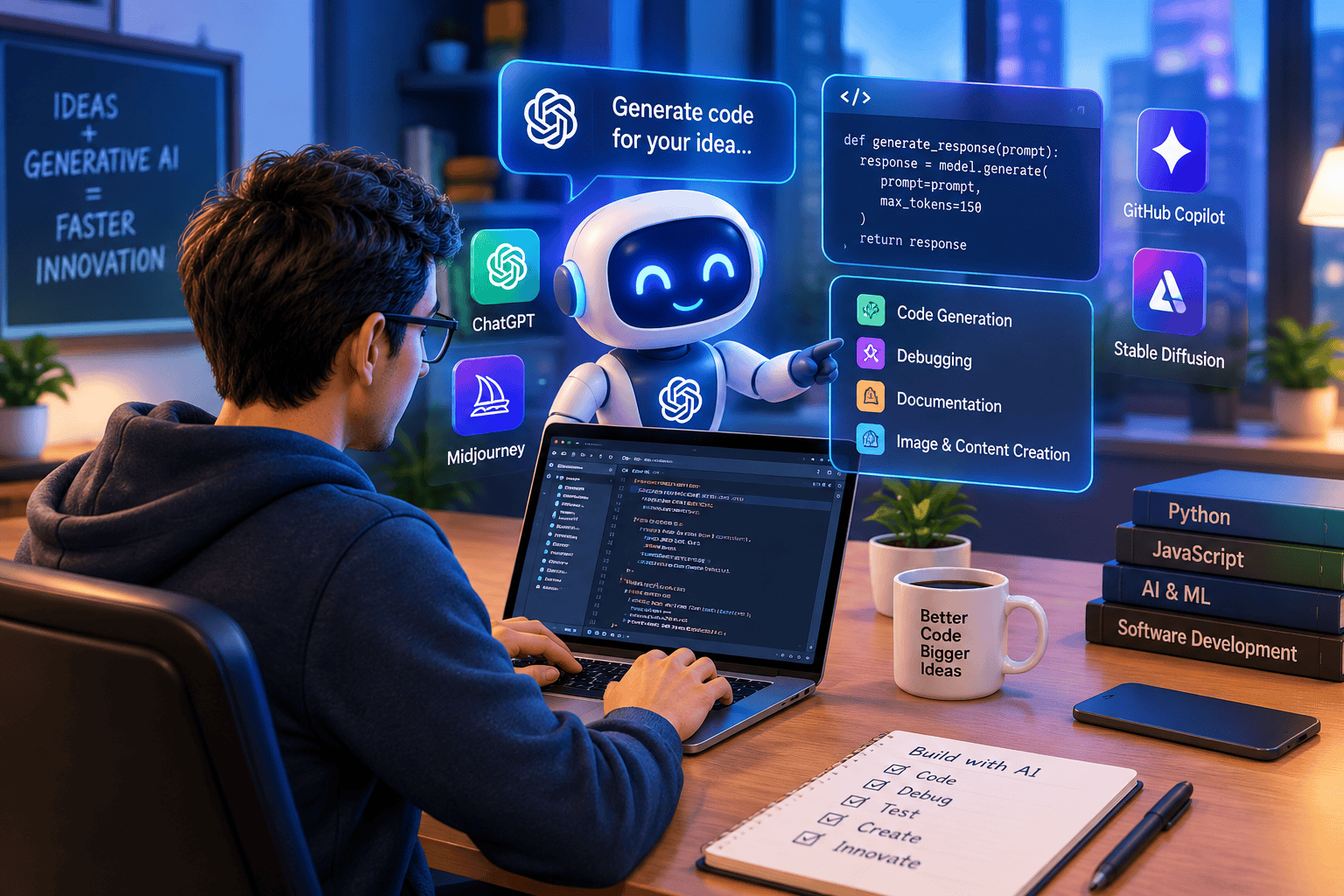
Developers using generative AI face a simple but high-stakes reality: when AI-written code ships with a bug, a security flaw, or a license violation, the responsibility doesn’t fall on the AI — it falls on the developer and the company that shipped it.
Picture a common scenario: a programmer hits a tough bug, pastes the code into a chatbot, gets a solution in seconds, and pushes it to production. Problem solved? Not quite — if that AI-generated fix contains an error, a security vulnerability, or simply doesn’t work as intended, the AI isn’t the one accountable. The developer and the organization are.
Generative AI is changing how software gets designed, developed, tested, and maintained. Developers using generative AI can lean on these tools for coding tasks, learning concepts, troubleshooting, documentation, and automating routine work. But having the tool doesn’t remove the engineer’s responsibility.
What Is Generative AI in Software Development?
Generative AI defines a manner of operation for AI systems that produce fresh content (such as text, programming code, etc.) following a request from a user. Furthermore, this application of generative AI entails producing source codes, drafting technical documentation papers, suggesting solutions, generating test scenarios, and providing help with software testing.
Adoption has moved well past early experimentation. According to Gartner’s 2026 enterprise research, the large majority of enterprises now use generative AI APIs or have deployed generative AI applications in production, and Stanford’s AI Index Report tracks a similar acceleration in AI-related regulatory activity over the same period — a signal that compliance, not just capability, is becoming part of the job.
AI tools help developers by handling repetitive work and offering useful suggestions. But AI output can still be incorrect, outdated, insecure, or simply ineffective for the actual problem at hand. The human factor remains essential.
Who’s Liable When AI-Generated Code Causes Problems?
This is the question every team eventually has to answer, and in 2026 the practical answer is consistent across the industry: using an AI tool does not transfer liability to the AI provider. The developer — and the organization shipping the code — remains accountable for what goes into production.
- Document your decision-making. If something breaks, being able to show you reviewed, tested, and used reasonable judgment matters for internal accountability and, in regulated industries, for compliance audits
- Know your organization’s AI policy. Some companies restrict which AI tools can be used, or require specific approval, insurance, or review steps for AI-assisted code
- Check your contracts. Employment agreements and client contracts increasingly include specific terms about AI tool usage and disclosure — know what you’ve agreed to
Copyright adds another layer. U.S. copyright law currently requires meaningful human creative contribution for a work to be copyrightable — the U.S. Copyright Office’s guidance on AI and copyright makes clear that purely AI-generated output, without meaningful human authorship, isn’t automatically protected. If your product or codebase includes AI-generated content, that’s worth understanding before you assume standard copyright protections apply.
Key Responsibilities of Developers Using Generative AI
Beyond the legal picture, day-to-day responsible use comes down to eight core practices.
1. Evaluating AI-Generated Code
One of the core tasks for developers using generative AI is inspecting AI-crafted code before trusting it. Although AI-generated scripts may look accurate, they can hide logic mistakes, inefficiency, or security vulnerabilities. Developers should understand how the code works before applying it — there’s no good reason to copy AI output and deploy it immediately. Review the logic, structure, dependencies, and compatibility of anything AI generates.
2. Testing AI-Generated Code
Testing matters just as much for AI-generated code as for handwritten code. Run unit tests, integration tests, and functional tests to catch shortcomings before software reaches users. Test with atypical, messy, or edge-case inputs specifically — AI models tend to perform reliably on simple, common scenarios and degrade on the inputs real users actually send.
3. Safeguarding Sensitive Data
Be cautious about what you share with generative AI tools. Source code, credentials, customer data, and confidential company information should only be shared with an AI system if your organization’s data security policy and the tool’s own security posture explicitly allow it. This is especially important in a professional context, where a careless prompt can leak sensitive data outside company control.
4. Looking for Security Weaknesses
AI-generated code can introduce security issues just like human-written code can — sometimes more subtly. Check generated code for common weaknesses around authentication, authorization, data handling, input validation, and dependency risk. Security testing should happen continuously throughout development, not as a one-time check before release.
5. Checking for Accuracy in AI-Generated Responses
Generative AI can produce answers that sound confident but are wrong — misunderstanding the prompt, suggesting an outdated library, or generating code that doesn’t actually do what was asked. Verify key technical details against reliable, current sources. Treat AI as a useful assistant, not the sole authority on a solution.
6. Following Copyright and Licensing Rules
Developers using generative AI need to stay mindful of intellectual property and licensing obligations. Third-party libraries, frameworks, and code snippets that show up in AI output can still carry licensing requirements. Follow your organization’s policies and don’t assume AI-generated code is automatically free to use commercially — tracking licensing conditions carefully can keep your team out of legal trouble.
7. Maintaining Human Vigilance
AI can assist, but developers still need to own the important decisions. AI use shouldn’t replace human judgment on matters of safety, security, reliability, or significant business impact. Human vigilance is what ensures the software actually meets its requirements and holds up in real-world use.
8. Knowing the Code They’re Using
Developers need a real understanding of AI-generated code before relying on it in production. Using unfamiliar, general-purpose code without understanding it tends to complicate debugging and future maintenance down the line. If an AI tool provides a complex solution, ask it to explain the approach, break the code into parts, and offer alternative implementations — then evaluate the correctness yourself rather than taking the first answer at face value.
Popular Tools Developers Use Today
As of 2026, GitHub Copilot and Cursor are among the most widely used AI coding assistants, alongside general-purpose tools like ChatGPT for explaining concepts or drafting documentation. Which tool fits best usually comes down to your editor, your tech stack, and whether your team needs on-premise or enterprise-grade deployment. Regardless of the tool, every responsibility covered in this guide — review, testing, security, licensing — applies the same way.
Benefits of Responsible AI-Assisted Development
Responsible use of generative AI provides significant benefits. Developers can quickly address monotonous coding chores, develop preliminary test scenarios, create more user-friendly technical papers, and find answers much faster than starting from scratch.
AI can additionally serve as an educational assistant — enabling programmers to master new programming languages, concepts, or specific lines of code. Nevertheless, these advantages can be achieved only with the support of human intuition and expertise.
Best Practices for Developers Using Generative AI
- Evaluate every significant AI-generated solution before using it
- Test the generated code the same way you’d test handwritten code
- Never share confidential or sensitive information without prior approval
- Check for dependencies and licensing requirements in generated code
- Verify important technical details against current, reliable sources
- Conduct security testing and code review throughout the project, not just at the end
- Keep documentation updated as AI-assisted changes are made
- Follow your organization’s AI and software development policies
- Keep human oversight in place for crucial, high-impact decisions
Combined with a solid software testing process, these practices make AI-assisted development measurably more secure and trustworthy.
The Future of AI-Assisted Software Development
The importance of generative AI in the software development process will continue to rise as assistance in writing code, carrying out tests, generating documentation, and debugging becomes more advanced, but the developers’ jobs will not be eliminated as they will continue to play their role in evaluating the AI’s results, making the technical decisions, controlling risks, and ensuring that the quality and safety of the final product are as required.
Conclusion
The role of developers who are utilizing generative AI is more than just to produce code. Developers are responsible for ensuring the quality of the code that has been created by artificial intelligence, to take measures to protect confidential information, to keep the software secure, check licensing and copyright requirements, comprehend the location of liability, and give the necessary human oversight. AI can increase productivity only when it is used as a tool, not a substitute.
Frequently Asked Questions
What are the key responsibilities of developers utilizing generative AI?
Developers must check, assess, and confirm AI-created output while safeguarding sensitive data and ensuring the security, quality, licensing, and copyright of the output.
Can developers implement AI-generated code straight away without examination?
Absolutely not. AI-generated code might feature inaccuracies or breaches of security. Therefore, developers need to analyze and create a deep understanding of the code.
Is generative AI accountable for the code it produces?
No. Developers and their corporations are liable for their software products, not an AI system.
How important is security when it comes to generative AI usage?
AI-created code can contain security flaws and exposing sensitive data to an AI application might entail a privacy threat. For this reason, developers should stick to proper security policy during every step of the process.
How can developers utilize generative AI properly?
The developers use AI responsibly by evaluating the effectiveness of its output and thoroughly testing the generated code, as well as protecting the confidential information, making sure it is technically sound, checking the licensing conditions, and keeping human participation in all vital matters.
Will coding be taken over by generative AI?
Though it can take over certain aspects of programming, developers will still be required to handle the requirements, architecture, testing, security, decision-making, and maintenance of products. Thus, it may be more accurate to think of AI as an assistant to the development process than the developer being replaced by AI.
Who’s responsible for any issues stemming from AI-generated code in the US?
By the year 2026, it will be the responsibility of the developer and the developer’s company, since the use of any AI coding tool by itself does not change who is liable according to the law. In addition, employment contracts and client agreements will generally define the duties of the developers with respect to AI work.