ChatGPT has become one of the most widely used AI tools in the world, helping people write, code, research, and solve problems every day. But behind its simple chat interface sits a fairly specific technical classification — and understanding it helps explain both what ChatGPT is good at and where its limitations come from.
In short, ChatGPT isn’t just one thing. It sits at the intersection of several overlapping categories within generative AI. This guide breaks down exactly where it fits.
If you’re also curious how teams are putting these models to work in practice, our guide on Developers Using Generative AI: Roles, Risks & Best Practices covers that side of the picture.
Generative AI: The Broadest Category
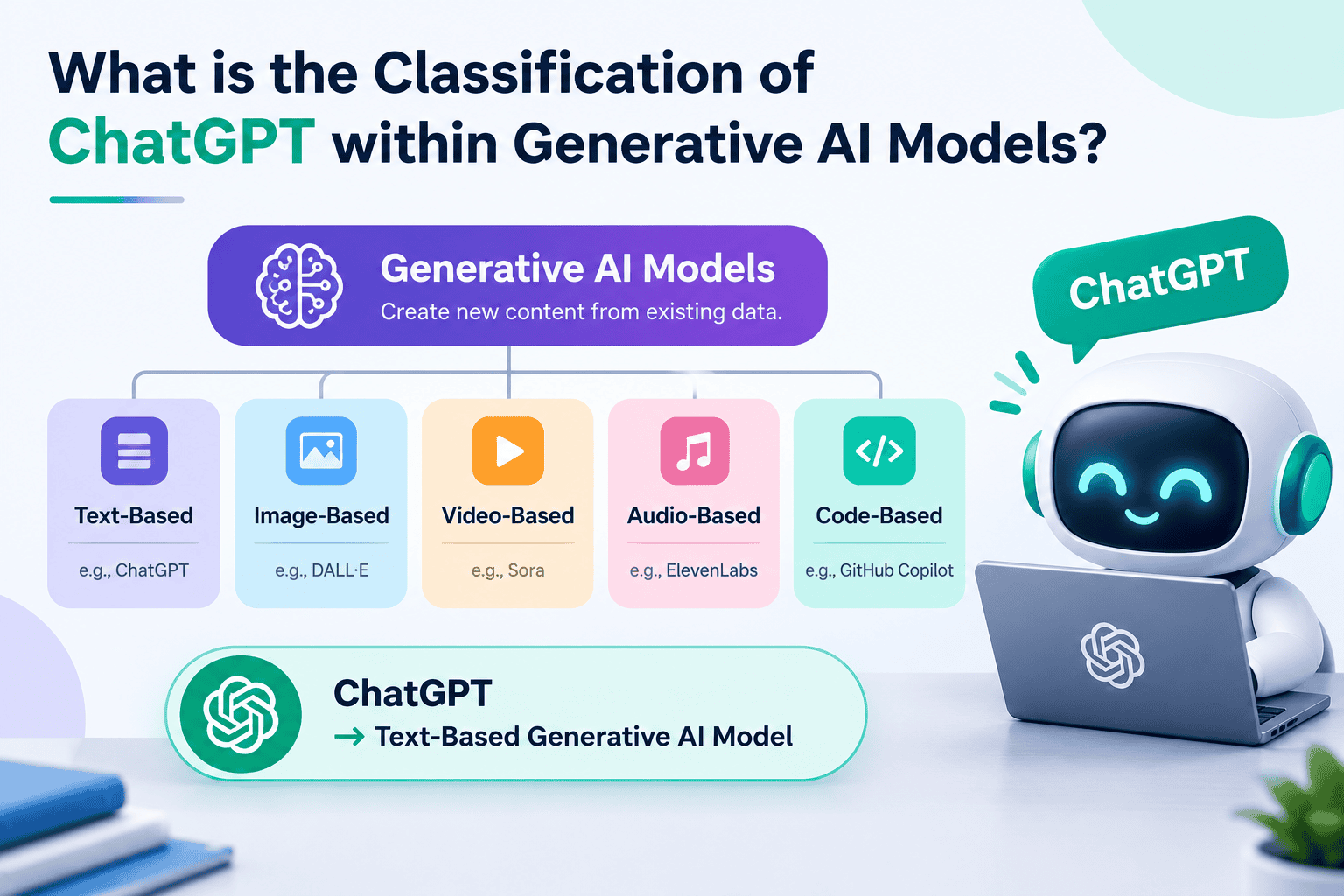
Generative AI is a branch of artificial intelligence focused on creating new content — text, images, audio, video, or code — rather than simply analyzing or classifying existing data. A traditional AI model might predict whether an email is spam; a generative model can write the email itself.
Within this broad category, generative AI splits into several types based on what kind of content they produce: text generators, image generators (like diffusion models), audio generators, and code generators. ChatGPT falls specifically under text-based generative AI.
Layer 1: Large Language Model (LLM)
At its core, ChatGPT is classified as a Large Language Model. LLMs are generative AI systems trained on massive volumes of text — books, articles, websites, and conversations — to learn the statistical patterns of human language. This training allows an LLM to predict, word by word, what a coherent and contextually appropriate response should look like.
The “large” in LLM refers to scale: these models contain billions of parameters, the internal values a neural network adjusts during training to capture nuanced patterns in grammar, meaning, and even reasoning. This scale is a key reason ChatGPT can generate fluent, contextually aware text across a huge range of topics, rather than being limited to narrow, pre-written responses.
Layer 2: Transformer-Based Architecture
ChatGPT’s LLM foundation is built on the transformer architecture, introduced in 2017. Before transformers, language models struggled to track relationships between words that were far apart in a sentence or paragraph. Transformers solved this using a mechanism called self-attention, which allows the model to weigh the importance of every word in relation to every other word, regardless of distance in the text.
This is what allows ChatGPT to maintain context across a long conversation, understand references back to something said several messages earlier, and generate text that stays coherent over paragraphs rather than just sentences.
More specifically, ChatGPT belongs to the GPT (Generative Pre-trained Transformer) family — a decoder-only transformer design optimized specifically for generating text one token at a time, rather than just analyzing or classifying it. This distinguishes it from encoder-based models (like BERT) that are built for understanding text rather than producing it.
Layer 3: Conversational AI
Beyond its underlying architecture, ChatGPT is also classified as Conversational AI — a category of systems specifically designed to interact with users in a natural, back-and-forth dialogue format, whether through text or voice. This layer is what turns a raw language model into a usable chatbot: it involves additional training focused on following instructions, maintaining conversational context, and responding helpfully rather than simply completing text.
Layer 4: Fine-Tuned with RLHF
A raw, pre-trained language model isn’t naturally good at following instructions or staying safe and helpful — it’s simply predicting likely next words based on its training data. To turn that into a useful assistant, ChatGPT undergoes an additional training phase called Reinforcement Learning from Human Feedback (RLHF).
In this process, human reviewers rank different possible responses to a prompt, and the model is fine-tuned to favor responses people rate as more helpful, accurate, and appropriate. This step is a major reason ChatGPT feels more usable and controllable than an unrefined base model.
Application Layer vs. Foundation Model
One distinction worth understanding: ChatGPT itself is not the raw foundation model — it’s an application built on top of one. The foundation model is the underlying GPT system trained on vast text data; ChatGPT is the product layer that wraps that model in a conversational interface, safety systems, and instruction-following behavior. This is why the same underlying model architecture can power different products with different behaviors, depending on how it’s fine-tuned and deployed.
Putting It All Together
So, when someone asks what ChatGPT’s classification is, the accurate answer has several layers:
- Broad category: Generative AI
- Core technology: Large Language Model (LLM)
- Architecture: Transformer-based, specifically the GPT (decoder-only) design
- Functional category: Conversational AI
- Training refinement: Fine-tuned using RLHF for instruction-following and safety
No single label fully captures what ChatGPT is — it’s the combination of these layers that defines its capabilities and behavior.
If you’re exploring how this technology applies beyond just chatting with it, check out our guide on Developers Using Generative AI: Roles, Risks & Best Practices for a look at how these models are actually being used and managed in real projects.
Frequently Asked Questions
1. Is ChatGPT the same as an LLM?
Not exactly. ChatGPT is a conversational application built on top of an LLM. The LLM is the underlying technology; ChatGPT is the product that uses it, combined with additional training and interface design.
2. What makes ChatGPT different from image-generation AI like DALL·E?
ChatGPT is a text-based generative model built on transformer architecture, while tools like DALL·E uses diffusion models, a completely different architecture designed for generating images rather than language.
3. Why does ChatGPT sometimes give inconsistent answers?
Because it generates text based on learned patterns and probabilities rather than a fixed database of facts, its responses can vary depending on phrasing, context, and the specific model version being used.
4. What is RLHF, and why does it matter?
Reinforcement Learning from Human Feedback is a training step where human reviewers rank model outputs to teach it which responses are more helpful and appropriate. It’s a major reason ChatGPT is more usable than a raw, untrained language model.
5. Is ChatGPT considered “true” AI or just a language predictor?
ChatGPT doesn’t reason or understand language the way humans do — it generates text by predicting likely sequences based on patterns learned during training. This is still classified as AI, but specifically generative AI rather than general intelligence.