
That’s the real question, because people throw the phrase “generative AI” around like it’s a single tool you can point at any dataset and expect magic. It isn’t. Generative AI is remarkably good with certain kinds of data and genuinely mediocre with others, and knowing the difference is what separates a project that actually delivers value from one that quietly gets shelved six months in.
So let’s get specific: what kind of data does generative AI actually work well with, and why does it struggle everywhere else?
The Short Version
Generative AI is built to learn patterns from large volumes of unstructured or semi-structured data — text, images, audio, code — and then produce new, original content that follows those same patterns. It’s less suited to small, rigid, highly structured datasets where a simple formula or traditional database query would do the job faster and more reliably.
In other words: the messier and more example-rich the data, the more generative AI tends to shine. The smaller and more rule-based the data, the less it has to offer.
Unstructured Text
This is generative AI’s home turf, and it’s not close. Large language models are trained on enormous volumes of text — books, articles, conversations, code repositories — and that scale is exactly what lets them produce writing that reads naturally, answers questions, summarizes documents, or holds a conversation.
The key requirement here is volume and diversity. A model needs to see language used in thousands of different contexts before it can reliably generate new language that makes sense. That’s why text-based generative AI has advanced so much faster than some other domains — the internet simply handed these models more raw text than any other type of data.
Images and Visual Data
Image generation works on a similar principle, just with pixels instead of words. Models trained on millions of labeled images learn the visual patterns that define an object, a style, or a scene, and can then generate new images that never existed before, based on a text description.
What makes this data type well-suited to generative AI is the same thing that helps with text: huge, richly varied training sets. A model that’s seen a million photos of dogs in different lighting, breeds, and poses can generate a convincing new one. A model that’s seen fifty photos of a rare, obscure object usually can’t.
Audio and Speech
Generative AI has made real progress here too — synthesizing realistic speech, generating music, cloning voice patterns. The same underlying logic applies: audio is sequential data with learnable patterns (tone, rhythm, pronunciation), and enough training examples let a model learn to reproduce and remix those patterns convincingly.
Code
This one surprises people less now than it used to, but it’s worth calling out specifically. Code is, in a sense, just a very structured form of text, and generative AI models trained on massive public code repositories have gotten genuinely good at writing, completing, and explaining code. The pattern-based nature of programming languages — consistent syntax, common structures, repeated idioms — makes this a strong fit.
Where Generative AI Struggles
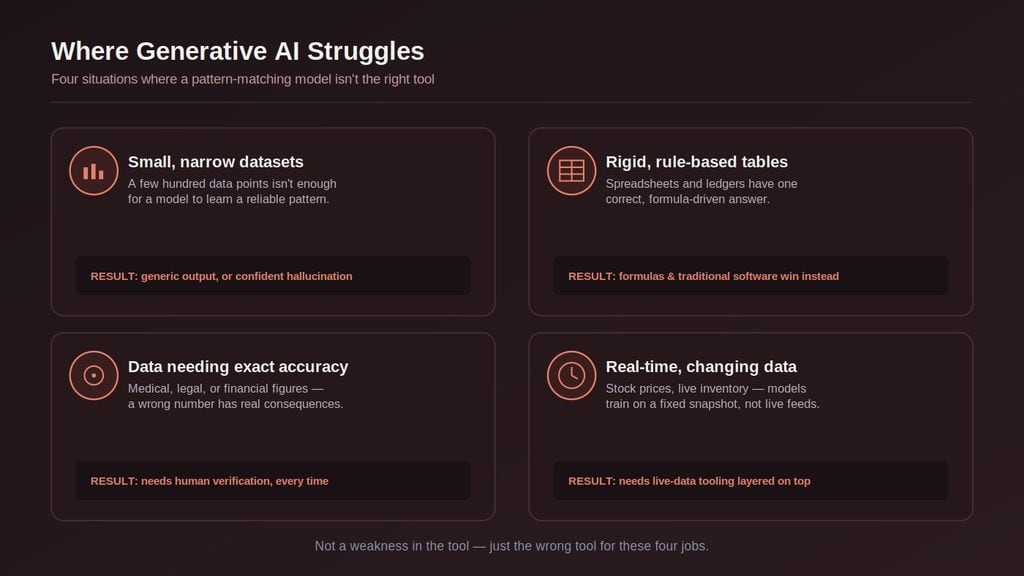
Here’s the part most explanations skip, and it matters just as much as the wins above.
Small, narrow datasets
If you only have a few hundred data points on a niche internal process, a generative model doesn’t have enough examples to learn a reliable pattern from. It’ll either produce generic output or confidently make things up — the classic “hallucination” problem gets worse, not better, on thin data.
Highly structured, rule-based data
Think spreadsheets with strict numeric relationships, financial ledgers, or database tables with fixed schemas. This kind of data usually has one correct answer, governed by formulas and business rules. Generative AI isn’t built for that kind of precision — traditional software, formulas, or even simple statistical models handle it better and more predictably.
Data requires perfect factual accuracy
Generative models are pattern generators, not fact-checkers. For data where a single wrong number has real consequences — medical dosages, legal figures, financial statements — relying on generative output without verification is a genuine risk, not just a minor limitation.
Real-time, constantly changing data
Most generative models are trained on a fixed snapshot of data. Without specific tooling to connect them to live data sources, they aren’t naturally suited to situations where the “right answer” changes hour to hour, like stock prices or live inventory counts.
The Pattern Behind the Pattern
If there’s one rule to take away from all of this, it’s this: generative AI is suited to data where the value lies in recognizing and reproducing patterns across large, varied examples — not data where the value lies in exact precision, small sample sizes, or strict logical rules.
That’s why the most successful generative AI applications tend to involve writing, design, code, and creative or exploratory tasks, while the least successful ones tend to involve precise calculations, small proprietary datasets, or situations where a single wrong output actually matters a lot.
Frequently Asked Questions
1. What type of data is generative AI most suitable for?
Generative AI works best with large volumes of unstructured or semi-structured data — text, images, audio, and code — where there’s enough variety for the model to learn reliable patterns and generate new, original content from them.
2. Can generative AI work well with small datasets?
Generally, no. Small datasets don’t give a model enough examples to learn a dependable pattern, which often leads to generic or inaccurate output. Small, specific datasets are usually better handled by traditional analytics or rule-based systems.
3. Why is generative AI bad at precise numerical tasks?
Generative models predict likely patterns rather than calculate exact values. For anything requiring guaranteed precision — like financial totals — traditional formulas or software are more reliable than generative output.
4. Is structured data like spreadsheets a good fit for generative AI?
Not typically. Highly structured data with fixed rules and relationships is usually handled better by conventional database queries or business logic, since generative AI isn’t designed to guarantee exact correctness.
5. Does more data always mean better generative AI results?
Generally yes, up to a point. More varied, high-quality data helps a model learn richer patterns. But data quality and diversity matter just as much as raw volume — a huge dataset full of repetitive or low-quality examples won’t produce great results either.