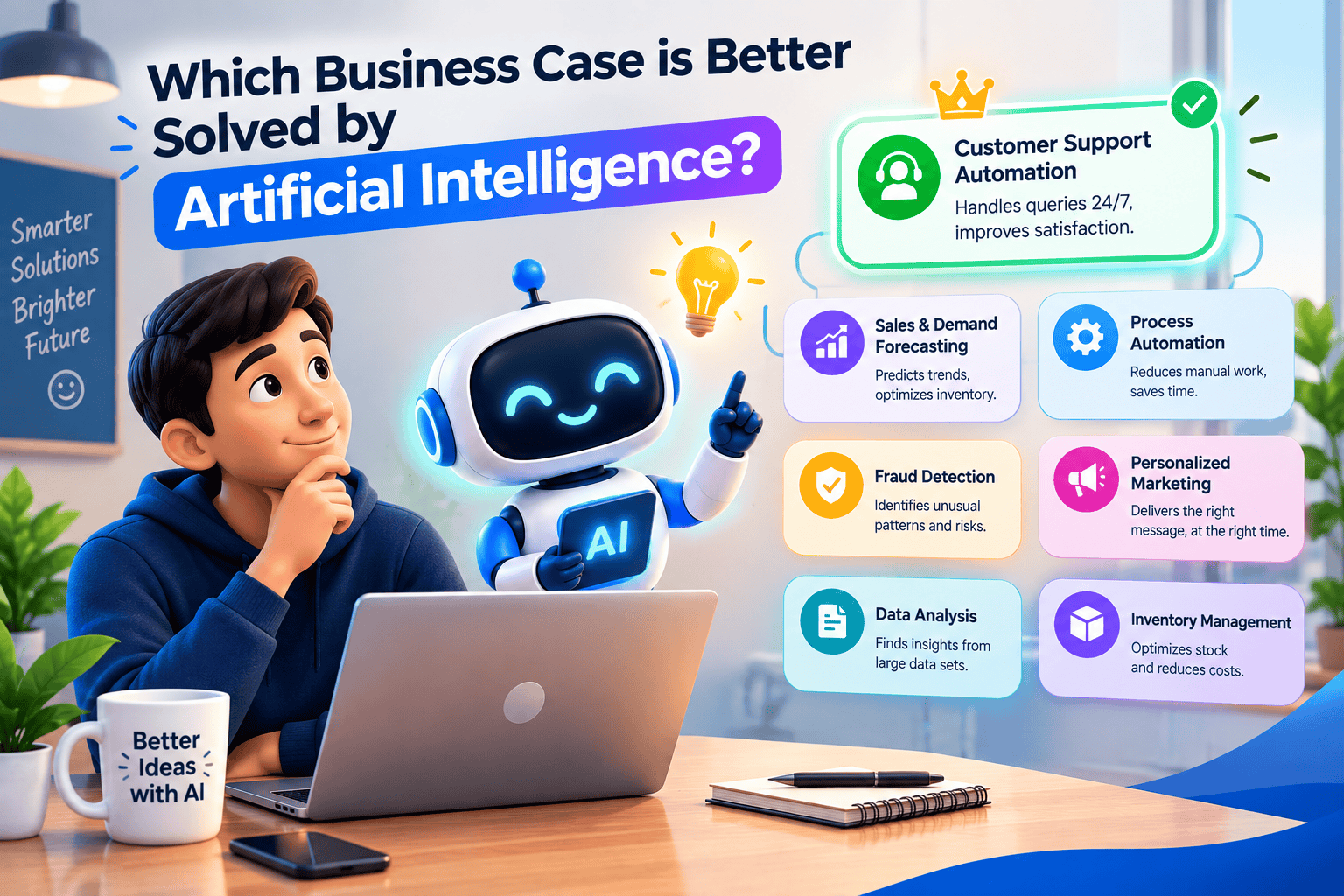
Every few months, someone in a leadership meeting asks the same question: “Should we be using AI for this?” And more often than not, nobody has a great answer. Not because AI isn’t useful — it clearly is — but because the question itself is too broad. AI isn’t a single tool that fixes everything. It’s genuinely brilliant at some kinds of business problems and honestly a poor fit for others.
So instead of asking whether your business should “use AI,” a better question is: which specific business case actually benefits from it? That’s what we’re digging into here — not the hype, just a clear-eyed look at where artificial intelligence solves real problems, and where it doesn’t.
The Short Answer: AI Wins When There’s a Pattern to Find
If you strip away all the buzzwords, AI is exceptionally good at one core thing: finding patterns in large amounts of data faster and more consistently than a human ever could. That’s it. That’s the whole trick. Every genuinely successful AI business case, when you look closely, comes down to some version of “there was a pattern buried in the noise, and AI found it.”
So the business cases that are “better solved” by AI tend to share a few traits: lots of historical data to learn from, a repeatable pattern worth detecting, and a cost of error that’s manageable rather than catastrophic. Let’s look at where that actually plays out.
Case 1: Predicting Customer Behavior
Trying to guess which customers are about to churn, which ones are ready to buy again, or which product a shopper is likely to want next — this is a textbook AI win. A human analyst might spot a few obvious warning signs of churn. A machine learning model can weigh dozens of subtle signals at once — login frequency, support ticket sentiment, time since last purchase — and catch patterns a person would never notice buried across thousands of accounts.
Retailers use this constantly for personalized recommendations. Subscription businesses use it to flag at-risk customers before they cancel, giving the team a chance to intervene while there’s still time.
Case 2: Detecting Fraud and Anomalies
This one’s almost the opposite of creative work, and that’s exactly why AI shines here. Fraud detection is about spotting the transaction that doesn’t fit the pattern — the one that’s slightly off from someone’s normal spending behavior, timing, or location. Humans reviewing transactions manually simply can’t keep pace with the volume, and they get fatigued, which is when mistakes creep in.
AI systems don’t get tired. They can flag a suspicious transaction in milliseconds, learn from confirmed fraud cases, and get sharper over time. Banks and payment processors have leaned on this for years now, and it’s one of the clearest, most measurable wins AI has delivered in business.
Case 3: Repetitive Customer Support Queries
Here’s a case that’s a little more nuanced. “Where’s my order?” “What’s your return policy?” “How do I reset my password?” These questions don’t need a thoughtful human — they need a fast, accurate answer, and AI chatbots handle this well now, especially when they’re connected to a proper knowledge base rather than guessing.
The important caveat: AI is well-suited to the predictable 70% of support questions, not the emotionally charged, genuinely complicated 30%. A customer furious about a billing error they’ve called about three times doesn’t want a bot — they want a person who can actually fix it. The businesses getting this right use AI to clear the easy stuff so human agents have room to focus where it matters.
Case 4: Demand Forecasting and Inventory Planning
If your business deals with physical inventory, this is one of the highest-ROI AI applications out there. Predicting how much stock you’ll need next month isn’t just about last year’s sales numbers — it’s influenced by seasonality, marketing spend, local events, even weather. That’s a lot of variables for a spreadsheet to juggle, but it’s exactly the kind of multi-variable pattern-matching AI is built for.
Get this right, and a business cuts both overstock (money sitting on a shelf) and stockouts (lost sales because the shelf was empty). Get it wrong, and you’re guessing — which is what most businesses were doing before this kind of forecasting became accessible.
Where AI Is Usually the Wrong Fit
It’s worth being honest about the flip side, because plenty of businesses waste money forcing AI into places it doesn’t belong.
Decisions with little historical data
If you’re launching something genuinely new with no track record to learn from, there’s no pattern for AI to find yet.
High-stakes judgment calls with real ambiguity
Firing someone, handling a sensitive PR crisis, negotiating a major partnership — these need human judgment, context, and accountability that AI can’t responsibly replace.
One-off, non-repeating problems
AI earns its value through scale and repetition. If a task only happens once, building an AI solution for it usually costs more effort than just doing it manually.
How to Actually Decide
A simple gut check works better than any framework: ask whether the task involves finding a pattern across a lot of examples, or making a judgment call in a genuinely unique situation. The former is AI’s home turf. The latter usually still belongs to a person, at least for now.
The businesses getting real value from AI aren’t the ones chasing every new tool — they’re the ones being specific about which problem they’re solving and why AI is actually a better fit than a human or a simpler piece of software would be.
Frequently Asked Questions
1. Which business case is better solved by artificial intelligence than by traditional software?
Any case involving pattern recognition across large, messy datasets — like fraud detection, churn prediction, or demand forecasting — is typically better solved by AI than by traditional rule-based software, because AI can adapt as patterns shift over time.
2. Can AI replace human decision-making in business entirely?
No. AI is strongest at repeatable, data-driven decisions. Judgment calls involving ethics, ambiguity, or high stakes with limited precedent still need human oversight.
3. What’s the easiest AI use case for a small business to start with?
Customer support automation for common questions is usually the easiest entry point — it has a clear ROI, doesn’t require massive amounts of proprietary data, and tools for it are widely available and affordable.
4. Why do some AI projects fail in business settings?
Most failures come down to applying AI to a problem that doesn’t actually have enough historical data or a clear pattern to learn from — or expecting it to handle nuanced judgment calls it was never suited for.
5. Does AI need a lot of data to work well for a business case?
Generally, yes. AI models improve with more relevant historical data. Businesses with limited data often see mediocre results until they’ve collected enough examples for the system to learn meaningful patterns from.