Most businesses hit a ceiling they don’t see coming. Revenue grows, orders increase, the team expands, and then suddenly everything feels like it’s held together with duct tape and spreadsheets. The operations that worked fine at $500K in annual revenue start cracking at $2M. Hiring more people to handle more volume isn’t scaling: it’s just growing, and growing expensively. The real unlock happens when you build systems that handle increased demand without a proportional increase in cost or headcount. That’s where automation solutions come in, and not the vague, buzzword-heavy kind you read about in vendor brochures. I’m talking about specific, practical tools and workflows that remove friction, reduce errors, and free your team to focus on work that actually requires a human brain. Whether you’re running a 15-person e-commerce brand or a 200-person services firm, the principles are the same. The businesses that scale well in 2026 are the ones that automated the right things at the right time, and this piece breaks down exactly how to think about that.
Defining Business Automation and Its Scaling Potential
Automation, stripped of marketing fluff, means using technology to perform tasks that previously required human effort. That could be anything from auto-generating invoices when a project closes to routing customer tickets to the right department based on keywords. The important part isn’t the technology itself: it’s what it enables. When you automate the repetitive, predictable parts of your business, you create capacity for growth without adding proportional overhead.
The Difference Between Growth and Scalability
Growth means more revenue. Scalability means more revenue without costs rising at the same rate. A company that hires three new customer service reps every time it adds 500 customers is growing. A company that deploys an automated ticketing system and only hires one rep for every 1,500 new customers is scaling. The distinction matters because growth without scalability eventually collapses under its own weight: margins shrink, quality drops, and the team burns out. Automation is the mechanism that creates the gap between revenue growth and cost growth.
Identifying Bottlenecks in Manual Processes
Before you automate anything, you need to know where the friction lives. Map out your core workflows: order fulfillment, client onboarding, invoicing, reporting, customer support. Look for the steps where work piles up, where errors happen most often, and where your highest-paid people spend time on tasks that don’t require their expertise. A marketing director manually pulling campaign metrics into a slide deck every Monday morning? That’s a bottleneck. An operations manager copying data between two systems because they don’t talk to each other? Another one. These are the spots where automation delivers the fastest return.
Optimizing Operational Efficiency Through Workflow Automation
Operational efficiency isn’t glamorous, but it’s where most businesses lose the most money. A 2025 McKinsey report estimated that knowledge workers spend roughly 28% of their week on email and another 20% searching for information or tracking down colleagues for approvals. Workflow automation targets exactly these kinds of time sinks.
Streamlining Repetitive Administrative Tasks
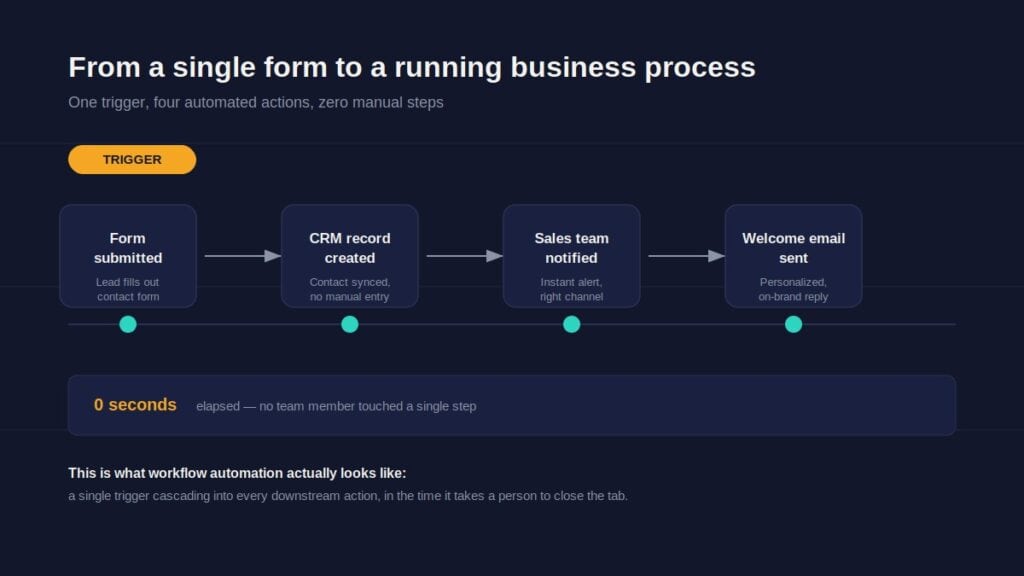
Think about the tasks your team does every single day that follow the same pattern: data entry, status updates, file organization, scheduling, approval routing. Tools like Zapier, Make, and Power Automate can connect your existing apps and trigger actions automatically. When a new lead fills out a form, the CRM record gets created, a Slack notification goes to the sales team, and a welcome email fires off: all without anyone touching it. One mid-size logistics company I’ve seen reduced their weekly administrative overhead by 14 hours per employee after automating just their purchase order and invoice matching process.
Enhancing Accuracy and Reducing Human Error
Humans are terrible at repetitive data tasks. We transpose numbers, skip rows, forget steps. A single pricing error in a proposal can cost thousands. Automated workflows don’t get tired, distracted, or bored. When you automate data transfer between systems, validation checks, and calculations, error rates drop dramatically. One study from the Institute for Robotic Process Automation found that bots achieve near-zero error rates on structured data tasks where humans typically operate at 95-98% accuracy. That 2-5% gap might sound small until you multiply it across thousands of transactions per month.
Accelerating Revenue Growth with Sales and Marketing Automation
Sales and marketing are where automation solutions often deliver the most visible ROI because the connection to revenue is direct. Every lead that falls through the cracks, every follow-up that doesn’t happen, every prospect who gets a generic message instead of a relevant one: those are dollars left on the table.
Lead Nurturing and Customer Journey Mapping
Most leads aren’t ready to buy when they first interact with your brand. The businesses that win are the ones that stay relevant during the consideration phase without requiring a salesperson to manually check in. Platforms like HubSpot, ActiveCampaign, and Salesforce Marketing Cloud let you build automated sequences that respond to prospect behavior. Someone downloads a pricing guide? They get a case study two days later. They visit the enterprise page three times? The sales team gets an alert. This kind of behavior-triggered nurturing consistently outperforms batch-and-blast email by 3-5x in conversion rates.
Automated Personalized Communication at Scale
Personalization used to mean inserting someone’s first name into an email. In 2026, it means dynamically adjusting content, timing, and channel based on a contact’s industry, behavior, purchase history, and engagement patterns. AI-powered tools can now generate personalized product recommendations, adjust email send times to individual open patterns, and even tailor landing page content in real time. The result is communication that feels one-to-one even when you’re reaching 50,000 people. A DTC skincare brand I followed went from a 1.8% email conversion rate to 4.3% after implementing dynamic content blocks tied to purchase history: no additional headcount required.
Leveraging Data Automation for Informed Decision Making
Data is only useful if it reaches the right person in the right format at the right time. Most businesses have plenty of data. What they lack is the automated infrastructure to turn it into decisions. Manual reporting is slow, inconsistent, and often outdated by the time it reaches a decision-maker’s desk.
Real-Time Reporting and Business Intelligence
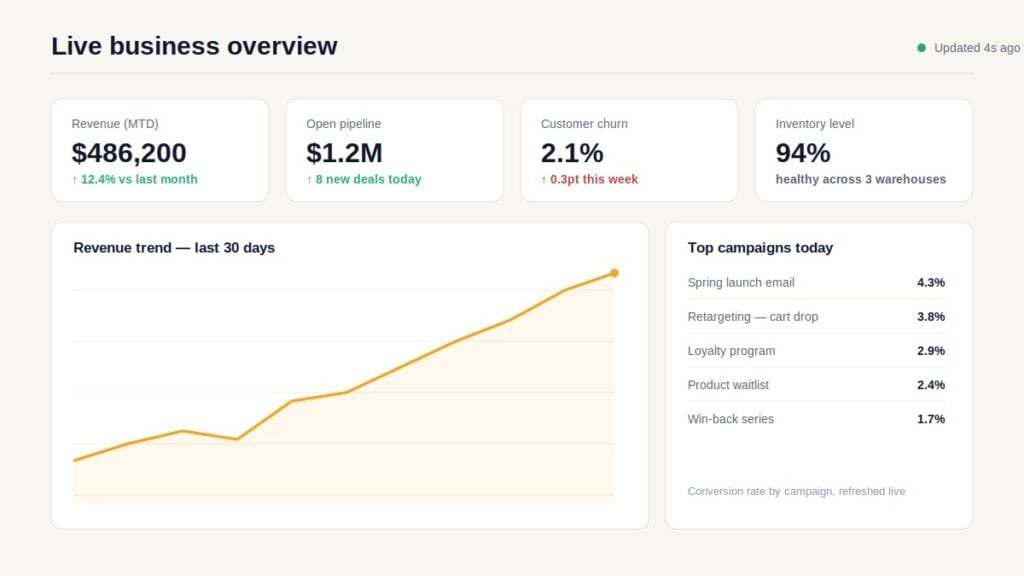
Tools like Looker, Tableau, and Power BI can pull from multiple data sources and update dashboards automatically. Instead of waiting for a weekly report that someone manually assembled, you get live views of revenue, pipeline, inventory levels, customer churn, and campaign performance. The shift from “we’ll know next week” to “we know right now” changes how fast a company can react. Real-time visibility into cash flow alone has saved businesses from making hiring or spending decisions based on stale numbers.
Predictive Analytics for Inventory and Demand
This is where automation for data gets genuinely powerful. Machine learning models can analyze historical sales data, seasonal patterns, marketing spend, and external factors like weather or economic indicators to forecast demand with surprising accuracy. For product-based businesses, this means reducing both stockouts and overstock situations. A mid-market food distributor using predictive demand tools cut their waste by 22% in the first year while simultaneously reducing out-of-stock incidents by 31%. The models improve over time as they ingest more data, which means the longer you run them, the better they get.
Strengthening Customer Retention with Automated Support
Acquiring a new customer costs five to seven times more than retaining an existing one. That stat has been floating around for years, but it remains true. Automated support systems don’t replace human agents: they handle the predictable stuff so your team can focus on complex, high-value interactions.
Self-Service Portals and AI Chatbots
By 2026, customers expect to resolve basic issues without waiting for a human. Self-service portals where customers can track orders, update billing info, download invoices, and manage subscriptions reduce support ticket volume by 30-50% on average. AI chatbots have improved significantly: modern versions built on large language models can handle nuanced questions, pull from your knowledge base, and escalate to a human when they hit their limits. The key is designing these systems with clear escalation paths. Nothing frustrates a customer more than being trapped in a chatbot loop when they have a genuinely complex problem. Done well, though, automated support improves both response times and customer satisfaction scores simultaneously.
Implementing a Sustainable Automation Strategy for Long-Term Success
Here’s where most businesses stumble. They buy tools before defining problems, automate processes that shouldn’t exist in the first place, or roll out changes so fast that the team revolts. A sustainable approach to business automation requires thoughtfulness about both technology and people.
Choosing the Right Tech Stack for Your Industry
Not every tool fits every business. A manufacturing company’s automation needs look nothing like a SaaS startup’s. Start with your core systems: your CRM, ERP, or project management platform. Then evaluate what integrates natively and what requires middleware. Here’s a practical framework:
- Identify your three highest-volume, most repetitive workflows
- Evaluate whether your existing tools can automate them with built-in features
- If not, look for purpose-built tools that integrate with your current stack
- Avoid building custom solutions unless off-the-shelf options genuinely can’t do the job
- Budget for implementation time, not just license costs: most automation projects take 2-4x longer to configure than vendors suggest
The best automation solutions for your business are the ones your team will actually use, which brings us to the human side.
Managing Organizational Change and Employee Buy-In
Automation fails more often because of people than technology. Employees worry about being replaced. Managers resist changing processes they built. Teams get frustrated when new tools don’t work perfectly on day one. Address this head-on. Be transparent about what automation will and won’t change about people’s roles. Involve end users in the selection and design process: they know the workflows better than anyone. Start with quick wins that make people’s daily work easier rather than leading with the big, disruptive changes. A phased rollout with feedback loops beats a company-wide launch every time.
Train people not just on how to use new tools, but on why the change matters and what it frees them up to do. The goal isn’t fewer people: it’s people doing more meaningful work while the system handles the rest.
Building Your Automation Roadmap
The businesses that scale successfully with automation share a common trait: they treat it as an ongoing strategy, not a one-time project. They start small, measure results, and expand based on what’s working. They don’t try to automate everything at once, and they don’t chase shiny tools without clear use cases.
If you’re just getting started, pick one bottleneck from your operations, one from your revenue engine, and one from your customer experience. Automate those three things well before moving on. Measure the time saved, the errors eliminated, and the revenue impact. Use those numbers to build the case for your next round of investment.
The companies that will dominate their markets over the next five years aren’t necessarily the ones with the biggest teams or the most funding. They’re the ones that built smart systems early, learned from the data those systems generated, and kept iterating. That’s the real promise of automation: not replacing humans, but giving them the infrastructure to do extraordinary work.
Final Thoughts
Scaling your business in 2026 isn’t about working harder; it’s about working smarter through strategic automation solutions. By identifying manual bottlenecks, optimizing workflows with tools like Zapier, and utilizing real-time data automation, you can unlock true scalability. Start small by automating your most repetitive task today, and watch your operational efficiency soar.