If you’ve recently explored Cadillac’s all-electric SUV or are planning to buy one, you may have wondered: do the driving modes in Cadillac Lyriq offer different ranges or battery usages? It’s a fair question because many electric vehicle owners want to maximize every mile from a full charge.
The short answer is yes—but not in the way many people assume.
Driving modes don’t magically increase the battery’s capacity. Instead, they adjust how the vehicle responds to acceleration, steering, regenerative braking, and climate settings. Those changes can influence how efficiently the battery is used, which may lead to noticeable differences in real-world driving range.
Let’s take a closer look at how these modes work and what they actually mean for everyday driving.
Understanding Cadillac Lyriq Driving Modes
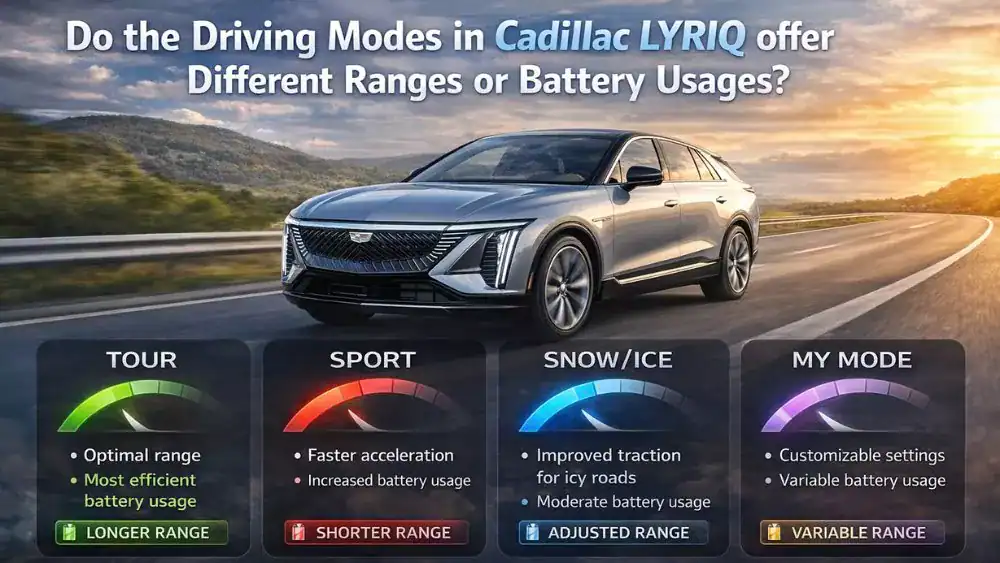
The Cadillac Lyriq is designed with multiple drive modes that tailor the vehicle’s behavior to different driving conditions and personal preferences. Depending on the model year and trim, available modes may include:
- Tour
- Sport
- Snow/Ice
- My Mode (customizable)
Each option modifies the SUV’s performance characteristics rather than changing the battery itself.
For example, one mode may deliver smoother acceleration for efficiency, while another offers quicker throttle response for a more engaging driving experience.
The battery pack remains the same regardless of the selected mode, but the way energy is consumed can vary.
How Driving Modes Affect Energy Consumption
Many drivers associate range exclusively with battery size, yet driving habits often play an equally important role.
Changing drive modes influences several vehicle systems that directly affect electricity consumption.
Accelerator Response
Sport mode provides faster and more aggressive acceleration. While this makes the Lyriq feel more responsive, stronger acceleration generally requires more electrical power.
Tour mode, by comparison, delivers power more gradually, helping reduce unnecessary energy use during everyday commuting.
Regenerative Braking
Electric vehicles recover energy while slowing down through regenerative braking.
Some driving settings encourage stronger energy recovery when lifting off the accelerator. In stop-and-go traffic, this can improve overall efficiency because more energy returns to the battery instead of being lost as heat through conventional braking.
Climate System Adjustments
Although climate control isn’t always tied directly to drive modes, efficiency-oriented settings often encourage reduced energy use from heating or air conditioning.
During extreme weather, HVAC usage can significantly affect available driving distance.
Which Driving Mode Is Most Efficient?
For most drivers, Tour mode offers the best balance between comfort and efficiency.
It promotes:
- Smooth acceleration
- Predictable power delivery
- Comfortable steering feel
- Lower energy demand during normal driving
Drivers who prioritize maximum range typically spend most of their time in this setting.
Sport mode remains enjoyable but usually consumes more electricity because it encourages quicker acceleration and higher performance.
Snow/Ice mode focuses on traction rather than efficiency, making it ideal for slippery roads even if it isn’t the most economical choice.
Comparison of Cadillac Lyriq Driving Modes
| Driving Mode | Primary Purpose | Energy Usage | Potential Effect on Range |
|---|---|---|---|
| Tour | Everyday driving | Low to moderate | Generally offers the best efficiency |
| Sport | Faster performance | Moderate to high | May slightly reduce driving range |
| Snow/Ice | Improved traction | Moderate | Depends on road conditions |
| My Mode | Personalized settings | Varies | Depends on driver configuration |
It’s important to remember that these differences are usually modest. Driving style has a much greater impact than simply switching between modes.
Driving Mode Performance in Daily Use
Imagine two Lyriq owners taking the same 100-mile trip.
The first driver selects Tour mode, accelerates smoothly, anticipates traffic, and uses regenerative braking whenever possible.
The second driver chooses Sport mode, frequently performs rapid acceleration, and brakes harder approaching intersections.
Even though both vehicles have identical batteries, the first driver will likely finish the trip with a higher remaining state of charge. The difference doesn’t come from the drive mode alone—it comes from how that mode influences driving behavior.
This illustrates why efficiency depends on both vehicle settings and driver habits.
Other Factors That Affect Driving Range More Than Drive Modes
While drive modes matter, several external variables have a much larger impact on battery performance.
Speed
Higher highway speeds create greater aerodynamic resistance.
Driving at 75 mph typically consumes more energy than cruising at 60 mph, regardless of the selected mode.
Outside Temperature
Cold weather temporarily reduces battery efficiency and increases heating demands.
Hot weather can also affect energy usage because the air conditioning system requires additional power.
Tire Pressure
Underinflated tires increase rolling resistance, forcing the vehicle to work harder.
Keeping tires properly inflated supports better efficiency.
Terrain
Climbing steep hills naturally consumes more energy than driving on flat roads.
Fortunately, regenerative braking helps recover some electricity during downhill sections.
Vehicle Load
Extra passengers, cargo, or roof-mounted accessories increase weight and aerodynamic drag, slightly reducing range.
Can Regenerative Braking Improve Battery Efficiency?
Absolutely.
One of the Lyriq’s biggest advantages is its regenerative braking system.
Instead of wasting kinetic energy when slowing down, the electric motor converts part of that energy back into electricity and stores it in the battery.
Drivers who become comfortable with one-pedal driving often notice improved efficiency during city driving.
I once experimented with smoother acceleration and heavier use of regenerative braking during a week of daily commuting, and the estimated remaining range consistently stayed higher than I expected despite following the same route.
Although results vary, many EV owners report similar experiences after adapting their driving style.
Is Sport Mode Bad for the Battery?
No.
Selecting Sport mode does not damage the battery.
The battery management system is designed to safely deliver higher power when requested.
However, frequent aggressive acceleration naturally consumes more stored energy, meaning you’ll likely recharge sooner than someone driving more conservatively.
Using Sport mode occasionally won’t noticeably affect long-term battery health.
Tips to Maximize Cadillac Lyriq Driving Range
If extending range is your priority, these habits often make a bigger difference than changing drive modes alone:
- Choose Tour mode for routine driving.
- Accelerate smoothly whenever possible.
- Maintain consistent highway speeds.
- Take advantage of regenerative braking.
- Keep tires properly inflated.
- Remove unnecessary cargo.
- Precondition the cabin while charging.
- Plan charging stops for longer trips.
Combined, these practices can noticeably improve overall efficiency throughout the year.
Does My Mode Help Save Battery?
My Mode allows drivers to customize elements like steering feel, braking characteristics, and responsiveness.
Whether it improves efficiency depends entirely on the chosen settings.
A configuration emphasizing gentle acceleration may perform similarly to Tour mode, while one favoring performance could consume energy closer to Sport mode.
The flexibility lets owners tailor the vehicle to their own driving preferences without permanently sacrificing comfort.
Read More: Is Xevotellos Model Good? Honest Performance Review
Conclusion
So, do the driving modes in Cadillac Lyriq offer different ranges or battery usages? Yes, but the effect is indirect rather than dramatic.
Drive modes influence how the SUV responds to driver inputs, which changes overall energy consumption. Tour mode generally delivers the best efficiency for everyday travel, while Sport mode prioritizes responsiveness at the expense of slightly higher battery usage. Snow/Ice mode improves stability in poor weather, and My Mode offers personalized customization based on your priorities.
Ultimately, consistent driving habits, vehicle maintenance, weather conditions, and road characteristics have a greater impact on real-world range than drive mode selection alone. Understanding how these factors work together helps drivers get the most from every charge while enjoying everything the Cadillac Lyriq has to offer.
FAQs
Does Tour mode always provide the longest driving range?
In most everyday conditions, Tour mode is the most energy-efficient option because it encourages smoother acceleration and balanced vehicle responses.
Can switching drive modes instantly increase battery range?
No. Changing modes doesn’t add battery capacity. It only changes how efficiently the vehicle uses available energy.
Is Sport mode worth using?
Yes. Sport mode delivers quicker acceleration and a more engaging driving experience. It simply uses electricity more aggressively during spirited driving.
Does regenerative braking charge the battery completely?
No. Regenerative braking recovers some energy that would otherwise be lost, but it cannot fully recharge the battery.
Should I always use one-pedal driving?
Many drivers find it improves efficiency in city traffic. However, the best choice depends on personal preference and driving conditions.