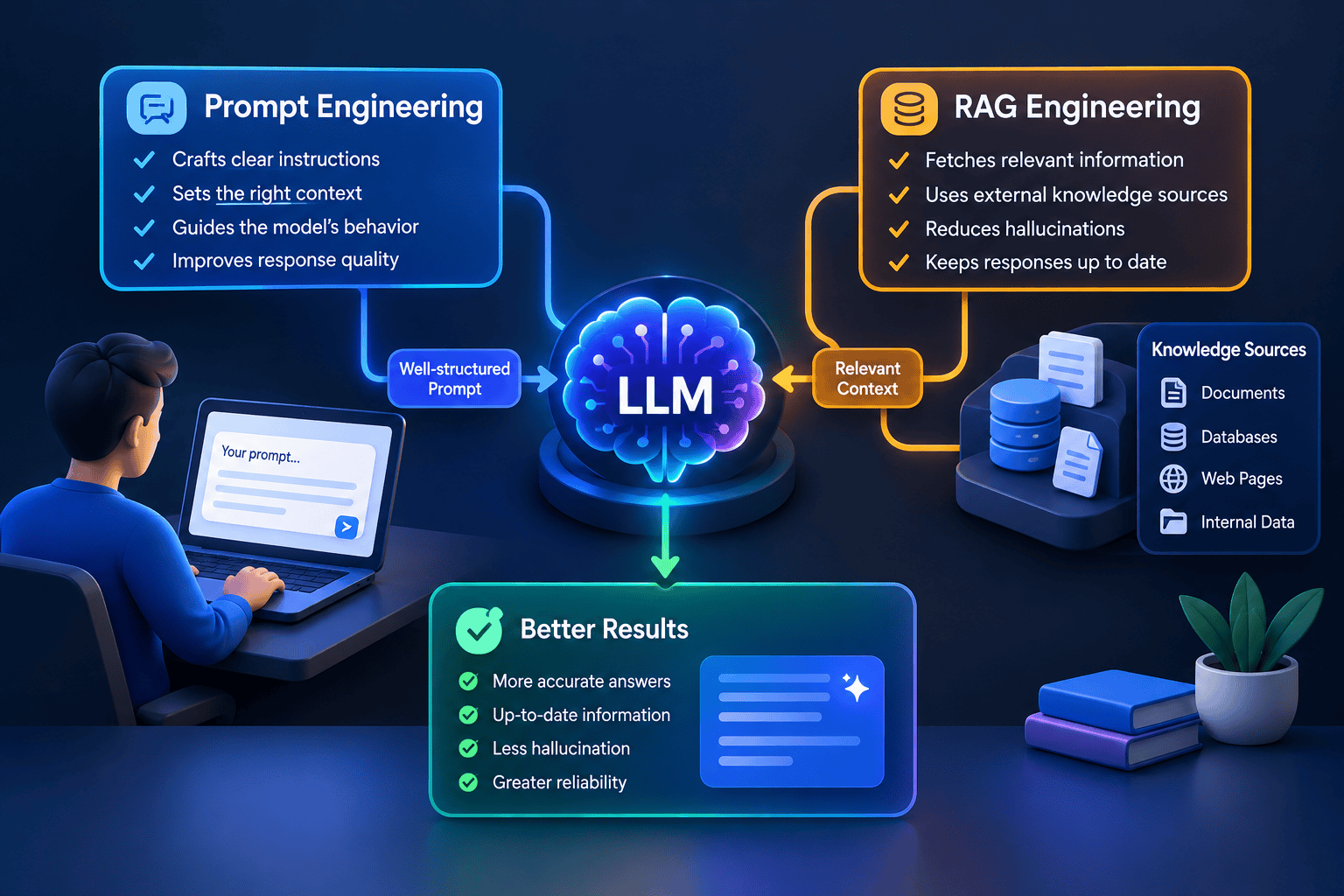
The most common mistake startups make when building an LLM application is treating retrieval and prompting as two separate problems solved by whoever happens to be available. They aren’t separate. A RAG pipeline can retrieve the exact right document and still produce a hallucinated, unusable answer if the prompt around it is poorly structured, and the sharpest prompt in the world can’t manufacture facts the model was never given in the first place. Startups that want a reliable LLM feature, not a demo that falls apart the first week real users touch it, eventually need to hire prompt engineers and hire RAG engineers who understand they’re solving one connected problem, not two independent ones.
What Each Piece Actually Does
A RAG engineer owns the retrieval side of the system: chunking documents sensibly, choosing and testing embedding models, building the vector search and reranking layer, and making sure the right document actually surfaces when a user asks a question. A prompt engineer owns what happens after that document arrives, structuring the instructions that determine how the model interprets and uses the retrieved content. One well-documented industry guide puts the relationship plainly: two RAG systems built on identical data, identical embeddings, and the same underlying model can behave completely differently, purely because of how the surrounding prompt is structured. Retrieval decides what the model sees. Prompting decides what the model does with it. A startup that only staffs one half of that equation is building half a system.
Why RAG Without Good Prompting Still Fails
Even a technically excellent retrieval pipeline can produce bad answers if the prompt wrapped around it doesn’t set clear rules. A model that receives the right document but no explicit instruction to stick to it will still happily fill in gaps with plausible-sounding details that were never in the source material. The fix that production teams have converged on is a dual-prompt structure: a system prompt that sets permanent rules, such as using only the retrieved context and admitting when information is missing, paired with a user prompt that carries the actual question. Separating these two layers stops short-term task instructions from quietly overriding long-term behavior rules, which is exactly the kind of failure a startup discovers only after a customer forwards a screenshot of a confidently wrong answer.
Why Prompting Alone Can’t Fix a Broken Retrieval Layer
The reverse failure is just as common, and arguably more dangerous because it looks like a prompting problem when it isn’t. When a RAG system produces a fabricated-sounding answer, the instinct is to rewrite the prompt. But language models are remarkably reliable at faithfully answering whatever context they’re actually given. If that context is wrong, no amount of prompt tuning fixes it. The real failure usually happens earlier in the pipeline: a table flattened into plain text loses the relationship between a row label and its value, a user’s phrasing doesn’t match the vocabulary used in the source document so retrieval misses the relevant section entirely, or keyword-based ranking buries the actually-relevant passage below the cutoff the model ever sees. This is precisely why a startup needs someone who can hire RAG engineers to fix parsing, vocabulary normalization, and retrieval ranking, not just someone rewording a prompt template and hoping the hallucinations stop.
A Concrete Example of the Two Working Together
Consider a staff training assistant built to answer employee questions from an internal knowledge base. The RAG layer retrieves the relevant policy document. The prompt layer then does the rest of the work that makes the answer trustworthy: an explicit refusal instruction telling the model to say it can’t find the answer rather than guessing, chain-of-thought guidance that reduces unsupported claims, and example outputs showing the exact format expected. The result is an answer that’s traceable directly back to a specific source document, not an answer that merely sounds confident. That traceability, not just correctness, is often the actual bar founders need to clear before they’ll trust an LLM feature enough to ship it to real customers.
Why Startups Get the Sequencing Wrong
Many early teams hire a single generalist and expect them to handle both retrieval architecture and prompt design, which works fine for a first prototype and starts breaking down the moment the product needs to be reliable rather than merely impressive in a demo. The two skill sets genuinely diverge as a product matures. Prompt engineering increasingly overlaps with what’s now called context engineering, structuring not just instructions but the full set of information a model receives. RAG engineering increasingly overlaps with data engineering and search infrastructure. A startup that recognizes this early, and decides deliberately when it’s time to hire prompt engineers with real context-engineering depth alongside RAG engineers who can fix retrieval at the pipeline level, avoids months of chasing hallucinations that were never actually a prompting problem to begin with.
Getting Both Hires Right
Because retrieval quality and prompt quality both fail silently rather than obviously, confirming a candidate’s actual depth in either specialty is harder than screening a resume for keywords like “RAG” or “prompt engineering.” Uplers runs candidates through a two-stage process combining AI-based screening with human technical validation, which helps founders who need to hire prompt engineers who understand context structuring and grounding, and separately helps them hire RAG engineers who can diagnose retrieval failures most teams don’t catch until production. A shortlist typically reaches a hiring team within 48 hours, with a replacement guarantee if the eventual fit doesn’t hold up.
The honest takeaway for any startup building on LLMs is that retrieval and prompting were never actually competing priorities. They’re two halves of the same trust problem, and a product that gets both right is the one that survives contact with real users instead of quietly degrading the moment nobody’s watching the demo anymore.